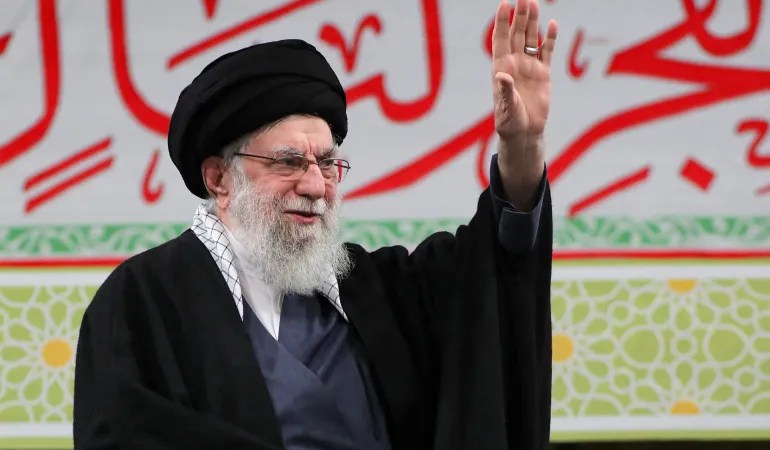
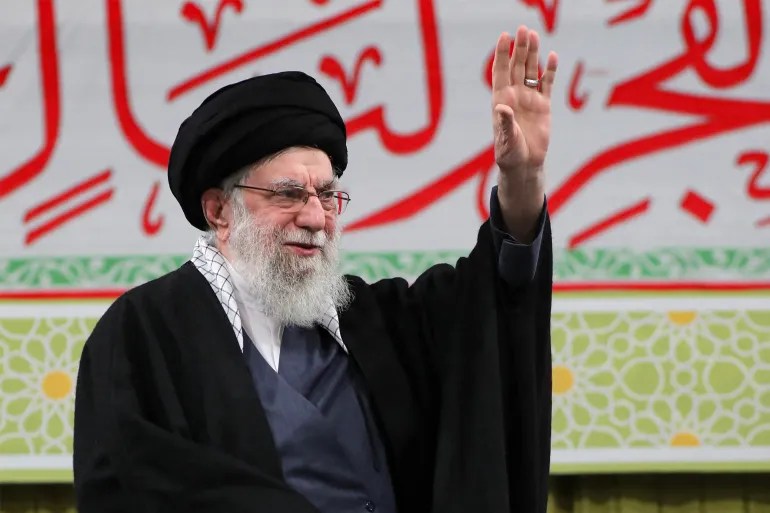
Iranian Supreme Leader Ali Khamenei has warned the United States that any attack on his country would result in a “regional war” as US President Donald Trump amasses military assets in the Middle East, according to Al Jazeera.
“They should know that if they start a war this time, it will be a regional war,” the 86-year-old supreme leader, who has held absolute power for 37 years, said at an event in downtown Tehran on Sunday.
He was speaking to a large crowd of supporters gathered to mark the anniversary of Ayatollah Ruhollah Khomeini’s return to Iran from exile in France in 1979, which led to the Iranian Revolution and the flight of the US-backed ruler, Mohammad Reza Shah Pahlavi.
Khamenei said the US wants to “devour” Iran and its vast oil and natural gas resources, adding that what happened during the recent antigovernment protests “was similar to a coup” since a large number of government offices, banks and mosques were stormed.
The supreme leader described the deadly unrest as another “sedition”, a term he had previously used for the 2009 Green Movement and other such protests.
“The recent sedition was similar to a coup. Of course, the coup was suppressed,” Khamenei said. “Their goal was to destroy sensitive and effective centres involved in running the country, and for this reason, they attacked the police, government centres, [Islamic Revolutionary Guard Corps or IRGC] facilities, banks and mosques and burned copies of the Quran.”
‘Iranians are in mourning’
The protests started on December 28 after shopkeepers in Tehran’s business district protested Iran’s rapid economic decline linked to local mismanagement and corruption, as well as the collapse of Iran’s currency, the rial, amid sanctions imposed by the US and its allies.
But the protests soon morphed into nationwide expressions of anger over curtailed personal and social freedoms, an acute energy and water crisis, and severe air pollution, among other things.
The United Nations, international rights groups, and foreign-based opponents of the Iranian establishment say thousands were shot dead or stabbed by security forces during the protests.
A UN special rapporteur said the number of fatalities may surpass 20,000 as more information – stifled by a weeks-old internet blackout – comes out. US-based activists allege there were 6,713 deaths, and claim they are investigating 17,000 others. Other sources cite even higher figures.
Iranian authorities maintain that “terrorists” armed and funded by the US and Israel were responsible for the mass killings. The country’s state media said the protests killed 3,117 people, with 2,427 being civilians and the remainder being members of the security forces.
President Masoud Pezeshkian this week promised to release the names and information of every person killed during the unrest soon, but has provided no timeline for this. His government also sent a text message to Iranians, saying the move will counter the “fake claims and figures”.
“One-way text messages cannot wash away the blood. Many Iranians are in mourning,” an Iranian woman told Al Jazeera.
‘Death to America’
In an apparent move to help calm the inflamed tensions within Iranian society, the government on Sunday sent another text message to citizens, telling them that women will soon be allowed to ride motorcycles in the country.
Iran’s laws have so far blocked women from riding motorcycles, while the state continues to impose a mandatory dress code and punish violators.
Inside the Iranian parliament, meanwhile, familiar images were witnessed on Sunday as hardline lawmakers once again donned IRGC uniforms and chanted “Death to America” with clenched fists.
The move was in reaction to the European Union earlier this week designating the IRGC as a “terrorist” organisation. Tehran responded by proscribing the bloc’s armed forces.
The IRGC, originally created shortly after the Iranian revolution to protect the fledgling theocratic establishment, has since transformed into a military powerhouse that also controls large parts of the Iranian economy.
“Such moves [by the EU] will not only fail to help with regional peace and security, but will also make the path of constructive engagement and coordination harder,” the IRGC said in a statement on Sunday in response to its blacklisting.
Meanwhile, Iranian officials are also holding “celebrations” across the country to mark the revolution’s anniversary and bolster its defiant messaging.
Troops from the IRGC and the army, joined by the police and other security personnel, marched on the streets of Tehran on Sunday in an apparent show of strength. Soldiers on motorcycles led a parade from Mehrabad Airport to the Behesht-e Zahra cemetery, where Khomeini delivered his first speech in 1979. Soldiers were also photographed at Khomeini’s mausoleum in Tehran as they “renewed their covenant with the goals and ideals of the revolution”.
Hamidreza Hajibabaei, who heads the committee organising the 10-day event marking the revolution’s anniversary, said on Sunday that large demonstrations will be held on February 11 across the country to “spell the end of the presence of global arrogance”.
In his speech, Khamenei also stressed the importance of state-run events, claiming that millions of people participated in a pro-government rally on January 12 while “mere thousands” rose up against the Islamic Republic during the nationwide protests.
Meanwhile, Iranian state television and other affiliated networks continue to broadcast programmes condemning the “riots” last month. A similar show on Ofogh, an IRGC-affiliated television channel, allegedly mocked the protesters, triggering angry online reactions and forcing the authorities to sack the channel’s director.
“They are only throwing more salt on our wounds,” a young student told Al Jazeera, requesting anonymity due to safety concerns. “They say all our youth were killed by terrorists, then go ahead and mock the people who laid down their lives on state television.”
 The Daily Wyvern