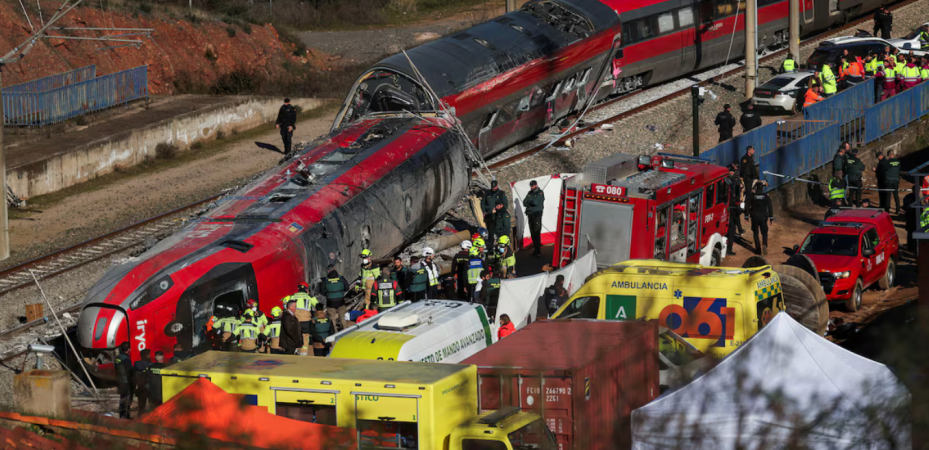
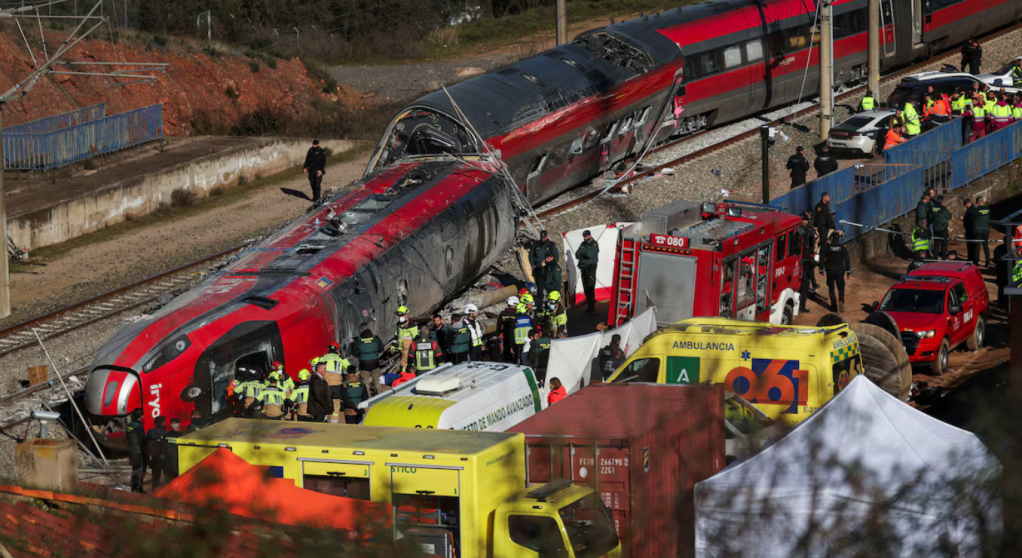
At least 39 people died in southern Spain after a high-speed train derailed and collided with an oncoming one on Sunday night in one of the worst railway accidents in Europe in the past 80 years, according to Reuters.
Twelve were in intensive care after the accident near Adamuz in the province of Cordoba, about 360 km (223 miles) south of Madrid, according to emergency services. Experts studying the crash site say a faulty rail joint may be key to determining the cause of the crash.
“The train tipped to one side… then everything went dark, and all I heard was screams,” said Ana Garcia Aranda, 26, who was travelling back to Madrid and was being treated at a Red Cross centre in Adamuz.
Limping and wrapped in a blanket, her face covered with plasters, she described how fellow passengers dragged her out of the train covered in blood. Firefighters rescued her pregnant sister from the wreckage and an ambulance took them both to hospital.
“There were people who were fine and others who were very, very badly injured. You had them right in front of you and you knew they were going to die, and you couldn’t do anything,” she said.
REMOTE LOCATION COMPLICATES RESCUE
The collision occurred in a hilly, olive-growing region which could only be accessed by a single-track road, making it difficult for ambulances to enter and exit, Iñigo Vila, national emergency director at the Spanish Red Cross, told Reuters.
Emergency teams were struggling to bring in heavy machinery that could lift the wreckage to get access to more of the dead, the Andalusia region’s President Juan Manuel Moreno said.
Spanish Prime Minister Pedro Sanchez cancelled his trip to the World Economic Forum in Davos, Switzerland, and Transport Minister Oscar Puente visited the crash site on Monday.
Police drone footage showed how the trains came to a standstill 500 metres apart. One train’s carriage was split in two, and the locomotive was crushed like a tin can.
Experts studying the crash site found a broken joint on the rails, which created a gap between the rail sections that widened as trains continued to travel on the track, according to a source briefed on initial investigations into the disaster.
The technicians believe the faulty joint could prove important in identifying the precise cause of the accident, the source said.
Spain’s Commission of Investigation of Rail Accidents (CIAF), which has been tasked with the overall investigation into the causes of the disaster, did not immediately respond to requests for comment.
Paqui, an Adamuz resident who with her husband rushed to help rescue survivors, described seeing body parts along the tracks between the two crash sites.
“(My husband) found a dead child inside, another child calling for his mother. You’re never ready to see something like this,” she said.
Police said they had opened an office in Cordoba for relatives to provide DNA samples to help identify the dead.
The Iryo train was travelling at 110 kph from Malaga to Madrid when it derailed, Renfe President Álvaro Fernandez Heredia said on radio station Cadena Ser.
Twenty seconds later, the second train, heading to Huelva at 200 kph, either collided with the final two carriages of the Iryo train or with debris on the line, he said. The Iryo train lost a wheel that has not yet been located.
It was too early to talk about the cause, but it happened in “strange conditions”, Fernandez Heredia said, adding that human error was virtually ruled out.
The death toll is among the top 20 highest from a train crash in Europe in 80 years, according to Eurostat data, and the highest in Spain since 2013, when a train derailed in the northwestern city of Santiago de Compostela, killing 80 people and injuring 145.
TRACK RENOVATED LAST YEAR
Spanish train drivers had warned state-owned rail infrastructure administrator Adif of “severe wear and tear” on the Madrid-Andalusia line and others, according to a letter seen by Reuters sent to Adif by train drivers union Semaf in August.
They had notified the operator daily of their concerns, calling for stricter speed restrictions until the issues were addressed.
Adif had no immediate comment.
The Iryo train, a Frecciarossa 1000, was under four years old and the railway line near Adamuz had been completely renovated last May as part of an investment of 700 million euros ($813.5 million), Puente said. Iryo said the train was last inspected on January 15.
Spain’s high-speed railway network is the largest in Europe and second-largest in the world after China with 3,622 km of tracks, according to Adif.
Around 10 million people used the high-speed railway connection between Madrid and Andalusia in 2024, according to competition authority CNMC.
The government was criticised last year for a series of delays to high speed rail, caused by power outages and the theft of copper cables from the lines.
Spain opened up the network to private competition in 2020 in a bid to offer low-cost alternatives to Renfe’s Ave trains.
Iryo is a joint venture between Italian state railway operator Ferrovie dello Stato, airline Air Nostrum and Spanish infrastructure investment fund Globalvia.
 The Daily Wyvern